






- Industrial LCD display
-
Industrial Products
- DC Servo Drive
- AC Servo Drive
- other
- Heidelberg
- FANUC
- IFM
- Meter
- CCD
- Membrane Keypad
- Film
- YOKOGAWA Module
- Card
- ABB
- MITSUBISHI
- FANUC
- KEYENCE
- BECKHOFF
- Honeywell
- HOLLYSYS
- FUJI servo drives
- HP
- solenoid valve
- thermostat
- Siemens adapter
- color oscilloscope
- Fujitsu connector
- CHELIC
- SMC
- CISCO Module
- INTEL
- Key board
- FAIRCHILD
- Motherboard
- Board
- Bearing
- other
- Control Panel
- Contactor
- Circuit
- OMRON
- Relay
- Controller
- Photoelectric Switch
- Photoelectric Sensor
- Original
- Fan
- Motor Driver
- Limit Switch
- Amplifier
- power supply
- LENZE
- Cable
- Encoder
- Sensor
- Transformer
- Fiber Optic Sensor
- Protection Relay
- Temperature Controller
- Proximity Switch
- Switch Sensor
- Siemens
- Industrial board
- HMI Touch Glass
-
HMI Full Machine Whole unit
- OMRON HMI Touch Panel
- Siemens HMI Touch Panel
- Mitsubishi HMI Touch Panel
- Allen-Bradley automation HMI Touch Panel
- DELTA HMI Touch Panel
- EVIEW DELTA HMI Touch Panel
- KINCO DELTA HMI Touch Panel
- HITECH HMI Touch Panel
- WEINTECK HMI Touch Panel
- TECVIEW HMI Touch Panel
- WEINVIEW HMI Touch Panel
- PRO-FACE HMI Touch Panel
- SIMATIC HMI Touch Panel
- AMPIRE HMI Touch Panel
- HEIDELBERG HMI Touch Panel
- PANASONIC HMI Touch Panel
- PATLITE HMI Touch Panel
- KYOCERA HMI Touch Panel
- KEYENCE HMI Touch Panel
- WEINVIEW HMI Touch Panel
- HITECH HMI Touch Panel
- FUJI HMI Touch Panel
- HAKKO HMI Touch Panel
- SCHNEIDER HMI Touch Panel
- SAMKOON touch panel
- other
- Module
- lcd inverter
- Membrane Keypad Switch
- Winni Touch Screens
- Frequency Inverter
- Servo Motor
- PLC



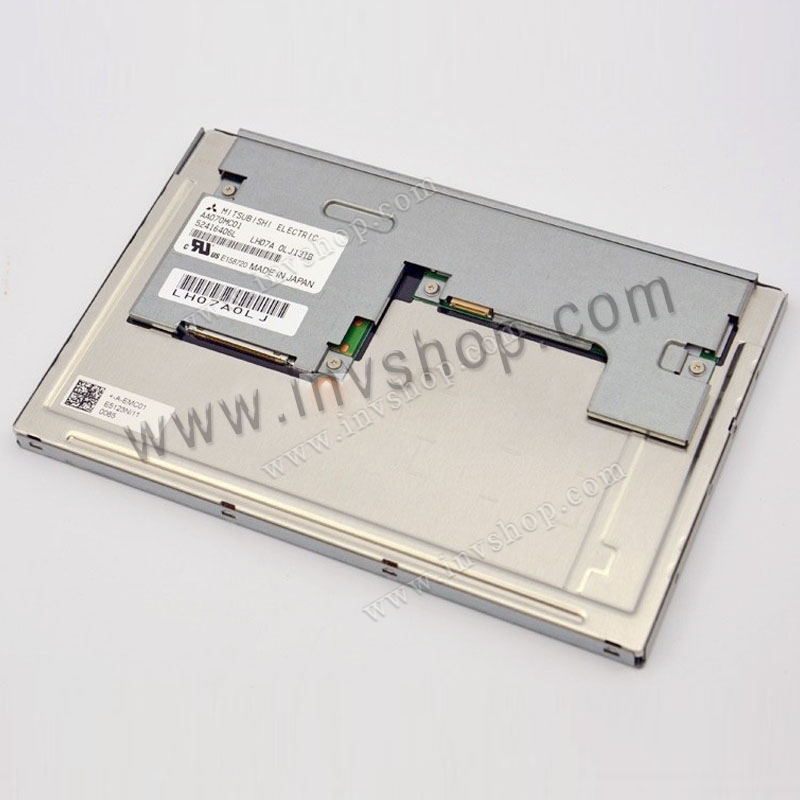
AA070MC01 Mitsubishi 7.0" 800*480 TFT-LCD DISPLAY
In the intricate world of industrial automation, human-machine interface (HMI) panels serve as the critical bridge between complex machinery and human operators. The choice of display directly impacts usability, reliability, and overall system performance. This article provides a comprehensive, in-depth analysis of the AA070MC01, a 7.0-inch TFT-LCD display module manufactured by Mitsubishi Electric, a titan in industrial technology.
We will move beyond basic datasheet specifications to explore the technical nuances, design philosophy, and practical application scenarios that define this component. Our examination will cover its core display technology, electrical and mechanical characteristics, the critical role of its interface and touch panel, its environmental robustness, and its ideal applications within the industrial ecosystem. Finally, we will address key considerations for system integration, empowering engineers and procurement specialists to make fully informed decisions for their next-generation HMI projects.
Core Technology: Deconstructing the 800x480 TFT-LCD
At the heart of the AA070MC01 lies a 7.0-inch diagonal Thin-Film Transistor Liquid Crystal Display (TFT-LCD) with a resolution of 800 pixels horizontally by 480 pixels vertically (WVGA). This specific resolution is a prevalent standard in industrial HMIs, offering a balanced compromise between display detail and cost-effectiveness for compact panels. The TFT technology is crucial, as each pixel is controlled by its own transistor, enabling faster response times, superior contrast, and wider viewing angles compared to older passive matrix displays.
The module likely employs an a-Si (amorphous Silicon) TFT process, which is highly mature and cost-optimal for this size and performance bracket. The 800x480 grid provides sufficient pixel density to render clear text, schematic symbols, and basic graphical user interface (GUI) elements without excessive processing overhead. The choice of a landscape orientation is standard for most control panels, facilitating the display of ladder logic, process flow diagrams, and data tables in a natural, wide format that aligns with human peripheral vision and scanning patterns.

Electrical and Mechanical Specifications: The Foundation of Reliability
The operational integrity of any industrial component is defined by its electrical and mechanical parameters. The AA070MC01 is designed as a module, typically requiring an external 3.3V or 5V power supply for the logic board and a higher voltage, often in the range of 12V to 20V, for the LCD backlight inverter or LED driver. This separation allows for flexible power management and dimming control.
Mechanically, the module features a rigid metal frame, ensuring dimensional stability and providing secure mounting points. The bezel dimensions and mounting hole patterns are standardized, facilitating drop-in replacement or integration into custom enclosures. A critical, often overlooked, mechanical aspect is the operating temperature range. Industrial displays must perform reliably in non-climate-controlled environments, from freezing cold factory floors to sweltering machinery rooms. The AA070MC01 is engineered to withstand such extremes, ensuring stable liquid crystal response and backlight performance where consumer-grade displays would fail.
Interface and Touch Panel: The Communication Channels
A display module is only as good as its ability to receive data and accept input. The AA070MC01 commonly features a LVDS (Low-Voltage Differential Signaling) interface for video data transmission. LVDS is preferred in industrial settings for its robustness against electromagnetic interference (EMI), low power consumption, and ability to transmit high-speed data over longer cable lengths compared to older TTL interfaces.
For user interaction, this module is frequently paired with a resistive touch overlay. Resistive touch technology, while not supporting multi-touch gestures, is ideal for industrial environments. It can be activated with a gloved hand, a stylus, or any pointing object, and is highly resistant to surface contaminants like dust, moisture, or light oil—commonplace in factories. The combination of a reliable LVDS signal path and a rugged resistive touch screen creates a dependable two-way communication channel between the machine's controller and the operator.
Environmental Durability and Optical Performance
Industrial environments are harsh. Beyond temperature swings, displays face vibration, potential shock, humidity, and high ambient light. The AA070MC01 is built to meet these challenges. Its construction mitigates the risks of condensation and ingress. The optical stack is designed for high brightness, typically ranging from 300 to 500 nits or more, to ensure readability under direct sunlight or bright factory lighting.
Furthermore, the panel incorporates technologies to enhance viewability. A wide viewing angle (often 70/70/50/70 degrees in Left/Right/Up/Down specifications) ensures that the display content remains visible to operators standing at different positions. Anti-glare treatment on the surface diffuses reflections from overhead lights, reducing eye strain and preventing "washout" of the image. These optical characteristics are not mere luxuries but essential features that guarantee the HMI fulfills its primary function: clear, unambiguous communication of system status.
Typical Applications in Industrial Automation
The AA070MC01 finds its niche in a wide array of industrial control and monitoring applications. Its size and resolution make it a perfect fit for:
Programmable Logic Controller (PLC) HMI Panels: As a dedicated operator terminal for controlling machinery, conveyor systems, and packaging lines.
Embedded Industrial PCs and Panel PCs: Serving as the integrated display for more complex computing platforms running SCADA (Supervisory Control and Data Acquisition) software.
Test and Measurement Equipment: Providing a visual interface for setting parameters and displaying readings on oscilloscopes, signal generators, and environmental test chambers.
Medical and Laboratory Devices: Where reliability and clear data presentation are paramount, such as in diagnostic equipment or analytical instruments.
Transportation and Heavy Equipment: In-cab displays for monitoring vehicle systems, forklifts, or agricultural machinery.
Integration Considerations and Lifespan
Successfully integrating the AA070MC01 into a product requires careful planning. Engineers must design a compatible power supply circuit, ensure the host controller has an LVDS transmitter or source an appropriate controller board, and develop a driver for the touch panel. Thermal management is also crucial; even efficient backlights generate heat that must be dissipated to maintain longevity.
A significant advantage of sourcing a display from a manufacturer like Mitsubishi is the long-term availability and product lifecycle. Unlike consumer displays that are redesigned every year, industrial modules are often produced for a decade or more. This is critical for OEMs (Original Equipment Manufacturers) who need to support their own products in the field for 15-20 years, ensuring a stable supply of replacement parts and avoiding costly mid-design requalifications.
FAQs: AA070MC01 Mitsubishi Display
10. Can I replace it with a consumer laptop screen?Not directly. Differences in interface (LVDS vs. eDP), mechanical mounting, power requirements, and lack of environmental hardening make consumer screens unsuitable for industrial replacement.
Conclusion
The Mitsubishi AA070MC01 is far more than a simple screen; it is a meticulously engineered component built for the demanding realities of industrial automation. Its value lies in the synergy of its robust TFT-LCD panel, reliable LVDS interface, rugged resistive touch option, and environmental hardening. These features collectively ensure clear visual communication and dependable operation in conditions where failure is not an option.
For system designers and engineers, selecting this module represents a strategic decision focused on long-term reliability, supply chain stability, and ultimate system integrity. It embodies the principle that in industrial applications, the interface is not just a window into the machine's soul, but a critical control point whose performance must be guaranteed. The AA070MC01 stands as a proven solution in this vital role.